LIGHT PILLAR
Berlin Film Festival 2026
Perspectives
-
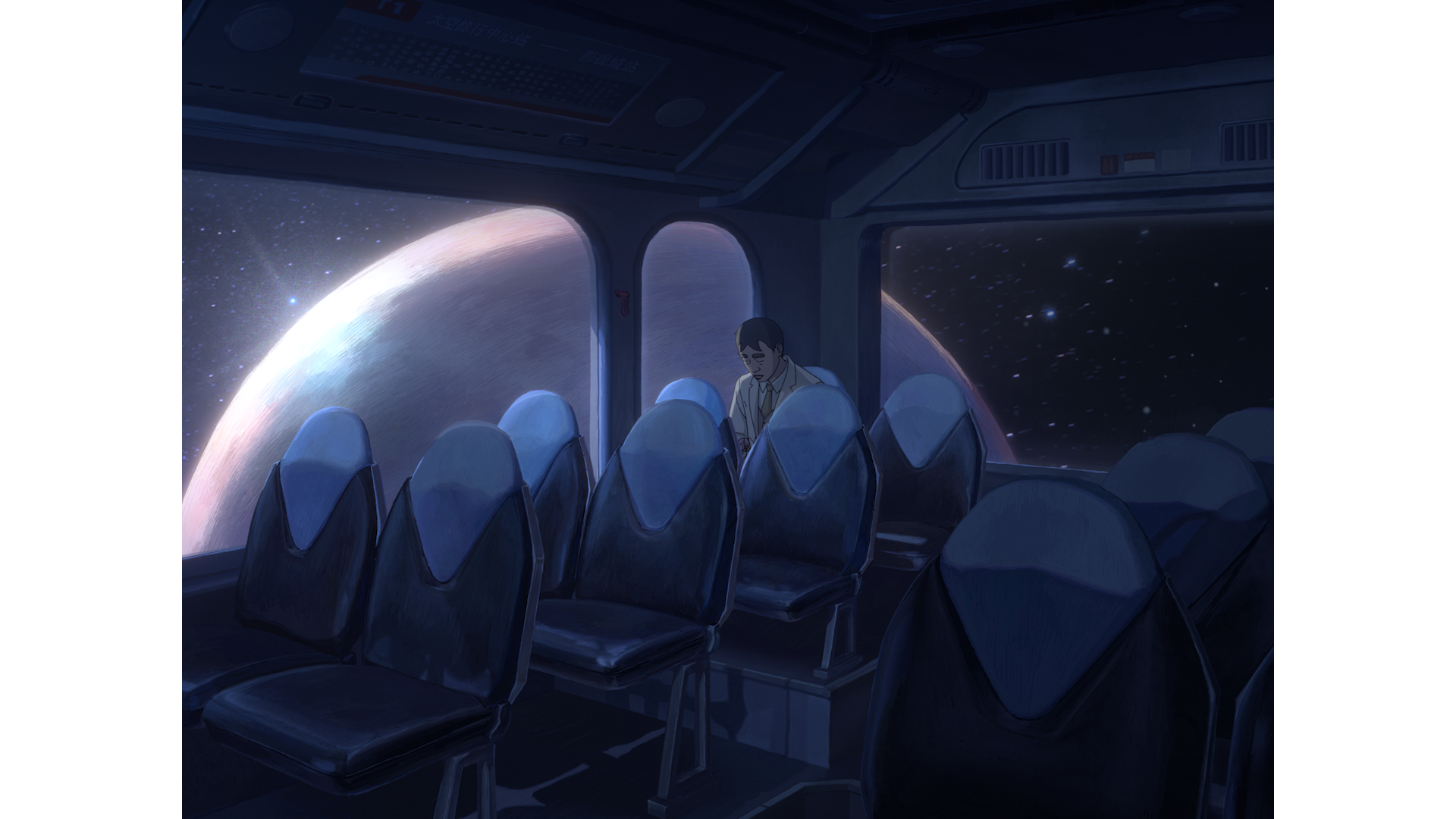
A bankrupt film studio lies frozen and abandoned. Zha, a lonely janitor, escapes his empty life through a vivid virtual world, where he enters an online romance and dreams of traveling to the Moon. When the illusion collapses, the studio’s real destruction is turned into the set of a sci-fi film.
-
Berlin Film Festival 2026 - Perspectives
-
OFFICIAL SCREENINGS
Fri 13 - 10 AM - Bluemax Theater (Press Screening)
Sat 14 - 9:45 PM - Bluemax Theater (World Premiere)
Sun 15 - 6:45 PM - Cubix 9
Mon 16 - 4:30 PM - Cubix 8
Wed 18 - 4 PM - Colosseum 1MARKET SCREENINGS
Sun 15 - 12:10 PM - CinemaxX 2
Sun 15 - 3 PM - Virtual Cinema 12
Mon 16 - 3 PM - Virtual Cinema 12 -
Gloria Zerbinati
gloria.zerbinati@gmail.com -
Director & Screenwriter Xu Zao Storyboard Xu Zao Cast Da Peng (as Lao Zha), Qing Yi (as Female Player) Editors Yang Chao, Xu Zao Art Director Xu Zao Animation Yang Leiting Compositing Zhu Liya Music Chen Xiaoshu Sound He Wei Camera Hao Jiayue Colorist Li Wentao Producer Lu Xiaowei Co-Producers Huang Yue, Shen Hancheng, Fu Xintong Executive Producer Da Peng Country of production China Production company Fengduan Pictures Year 2026 Category Animation/ Live-action Language Mandarin Run time 90' Original title Han ye deng zhu Sound format 5.1
-
Born in Anshan, Liaoning Province, China in 1991, the screenwriter, director and production designer studied at the Beijing Film Academy. His animated short No Changes Have Taken In Our Life premiered at the International Film Festival Rotterdam and won multiple national and international awards. His second short, Love Music Friend, screened at the Shanghai International Film Festival. Han ye deng zhu is his debut feature film.
-
Light pillar is a natural phenomenon. Why did you choose it as the title and main imagery of the film?
The phenomenon is very rare, and unfortunately I’ve never seen it in real life. The first time I saw it on television, I was immediately captivated by its mysterious and fantastical appearance. In the film, “Light Pillar” refers to a space travel program. The rocket trails resemble light pillars, which is why I chose the name. In essence, they represent the same idea: something visually stunning, yet out of reach. Why did you pick a janitor in a film studio as the protagonist?
What is the idea behind the film studio’s design, which blends Chinese and Western elements? Are there any details viewers should pay attention to?
I wanted to focus on someone who is often overlooked and forgotten, and a janitor felt like a natural choice. As a production designer, I visited more than a dozen film studios in China and closely observed the daily routines of the people working there. These observations gradually shaped the characters in the film. As for the design of the “Old New East West Film Studios,” most of the scenes are based on actual references. The studio town combines elements I found interesting in different film studios, and can be seen as a kind of miniature world. It also features iconic scenes from classic Chinese films, some of which no longer exist today. Through animation, I was able to revive these scenes, while also adding a new layer of meaning by infusing them with the emotions and atmosphere of our story. This process was especially satisfying.
You graduated from Beijing Film Academy. Did you develop your filmmaking style there?
Yes. I’d like to thank my school, because this project actually started there. I wrote the script while I was still a student. Since I was majoring in visual design, I often paid more attention to images, which is why there are so few lines in my films. Regarding visual language, I have an example from the beginning of the film. In one scene, Lao Zha (the janitor) is bullied by his colleagues, who smoke in the staff lounge. When he exits the lounge, the camera pulls back to reveal that the lounge is located at the back end of the Sphinx. In other words, he looks as if he were being pooped out of it. This sets up his character as a loser, but in an absurdist way, since the snow-covered Sphinx is not shown in its full glory either.Why did you use live-action filming to present the virtual world? Could you share any interesting stories from this hybrid filmmaking process?
To me, the real world feels increasingly abstract, while the virtual world is becoming more and more concrete. Many things in real life are hard to understand, confusing, and disorienting. In games, however, everything is very specific: you know what to do and where to go, guided by clear instructions. One of the most enjoyable parts of making animation was filming visual references. We bought complete sets of costumes, wigs, and even fake bellies. Members of the animation team often performed characters of the opposite sex; for example, Lao Zha was performed by a female colleague. We often failed because we were laughing so hard, which sometimes delayed the production. The live-action shoot was stressful mainly because of the tight schedule. We only had four days to film, and it rained every day before we started, which made us very anxious. During the pre-shooting blessing ceremony, we prayed for good weather, and it worked; we watched a huge cloud drift right past us. Thanks to the clear weather, we were able to complete this part of the shoot relatively smoothly.
This film seamlessly combines elements such as sci-fi, romance, comedy, and meta-cinema. Could you share the creative process behind this approach?
I usually work with a skeleton screenplay that focuses on the storyline and overall tone. This method gives me the freedom to improvise while drawing the storyboards. For example, during the early development stage, the film studio manager didn’t have a microphone or a dragon robe. When I moved into storyboarding —which, for me, is the process of turning something abstract into something concrete—I added these details to make this character more vivid and humorous. These kinds of improvisations enriched the film and often led to unexpected results.Your previous short film showcased a unique sense of humor, which also stands out in Light Pillar. Do you see this as part of your style?
Light Pillar is not hard-core science fiction, but is grounded in the daily life and struggles of our protagonist. When everyday life meets science fiction, comedy emerges naturally. It comes from what we perceive as normal, much like the strange humor of seeing a monkey type on a keyboard. About my style, this is not something I can change. I don’t think I deliberately pursue a specific style. Every decision in the creative process comes from the heart.
What challenges did you face making your debut feature?
Every step was a challenge. There’s virtually no precedent for independent productions like ours with such a small team. We had to figure out every process ourselves and create a workflow that only worked for us. Difficulties arose at almost every turn. Pre-production (writing and storyboarding), which lasted about six months, was truly exciting. However, the long principal production, which lasted over a year, became extremely monotonous and tedious, as we were essentially repeating what we had already established. It required patience, iron will, and physical endurance. I have to say, making 2D animation is like a form of exercise.
Any films, animations, or music that inspired you recently?
Recently, I’ve been listening to a piece called Aurora en Pekín. I interpret the title as “Northern Lights in Beijing.” It was written almost a hundred years ago by Cuban guitarist Alfredo Boloña Jiménez. Obviously, you can’t see the Northern Lights in Beijing, so I find the title both comic and charming. “Aurora” might also refer to a person, which would make it a love song. No matter how you interpret it, the piece is fascinating. I listened to Marc Ribot’s version a lot; the wooden percussion in it sounds beautiful.
I’d like to know more about He Bao, the cat actor. What’s his story?
The cat’s appearance is based on an actor I really admire, Xue Baohe. Simply put, I designed him around the actor’s personality. That’s why he’s called He Bao, the reverse of Baohe.If you look closely, you’ll notice he once won Best Actor. As shown in the red- carpet photo, he used to have a beautiful, large tail, but now his tail is shorter.
It symbolizes trauma: the change from a fluffy tail to a short one suggests everything he has been through. Yet he remains strong and carefree. That’s why, in the end, he appears to save Lao Zha.
-
Coming soon.
-
Presskit
Stills
Clips
Poster
Dialog List -
Please write to Sebastien <sebastien@cercamon.biz> if you would like to receive a screening link if you are a Distributor/ TV buyer/ SVOD platform and would like to check the film for a potential acquisition for your territory.
Please write to Dorian <dorian@cercamon.biz> if you would like to receive a screening link if you are a Festival Programmer/ Institution and would like to screen the film for this purpose.
-
You are inquiring about renting LIGHT PILLAR by Xu Zao for a screening in a Festival, educational purposes or for a non-for profit institution.
Kindly write to Dorian <dorian@cercamon.biz>, Cc Sebastien <sebastien@cercamon.biz>.providing the following information to help us quote you a rental fee:
Institution Name:
Your Name:
Your email:
Type of screening: festival screening / Commercial screening (Independent Theater) / Open showing / Classroom / Other
Number of screening (and size of the venue):
Thank you!
Directed by Xu Zao